
For judges: how Chaperone works, and how to check it
CloudTrail records an AI agent's AWS calls as the developer's own. Chaperone pulls them apart: the agent session, each MCP tool call, and every AWS call that tool made.
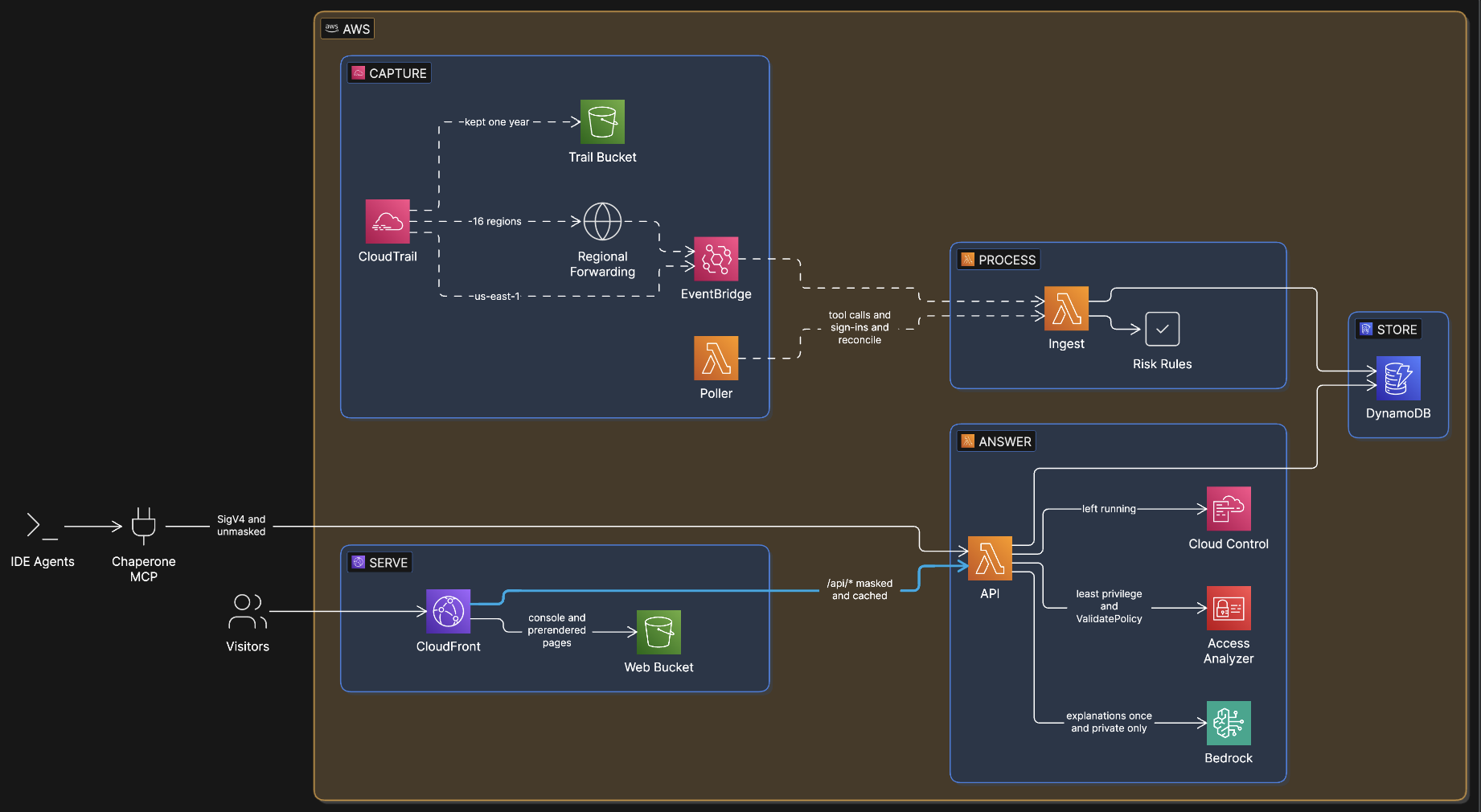
The diagram, in words
- 1
Capture
CloudTrail records every AWS call in all regions. EventBridge forwards each one to us-east-1 within seconds; a poller Lambda fetches MCP tool calls and sign-ins every minute.
- 2
Process
An ingest Lambda files each call under who made it (agent or person), notes the channel (MCP, Terraform, CLI, SDK, console) and classes its risk with fixed rules.
- 3
Store
One DynamoDB table, events kept per actor for 90 days. Sessions are built when read, and each MCP tool call is joined to its AWS calls by request ID.
- 4
Answer
One API Lambda answers every question, with Cloud Control (what was left running), IAM Access Analyzer (least privilege) and Bedrock (a summary written once per session).
- 5
Serve
The MCP server calls it signed and unmasked. This site calls it through CloudFront, masked and read-only. Scripts and CI can call it signed too.
One API, three ways in
MCP is one door. The same answers reach people and pipelines too.
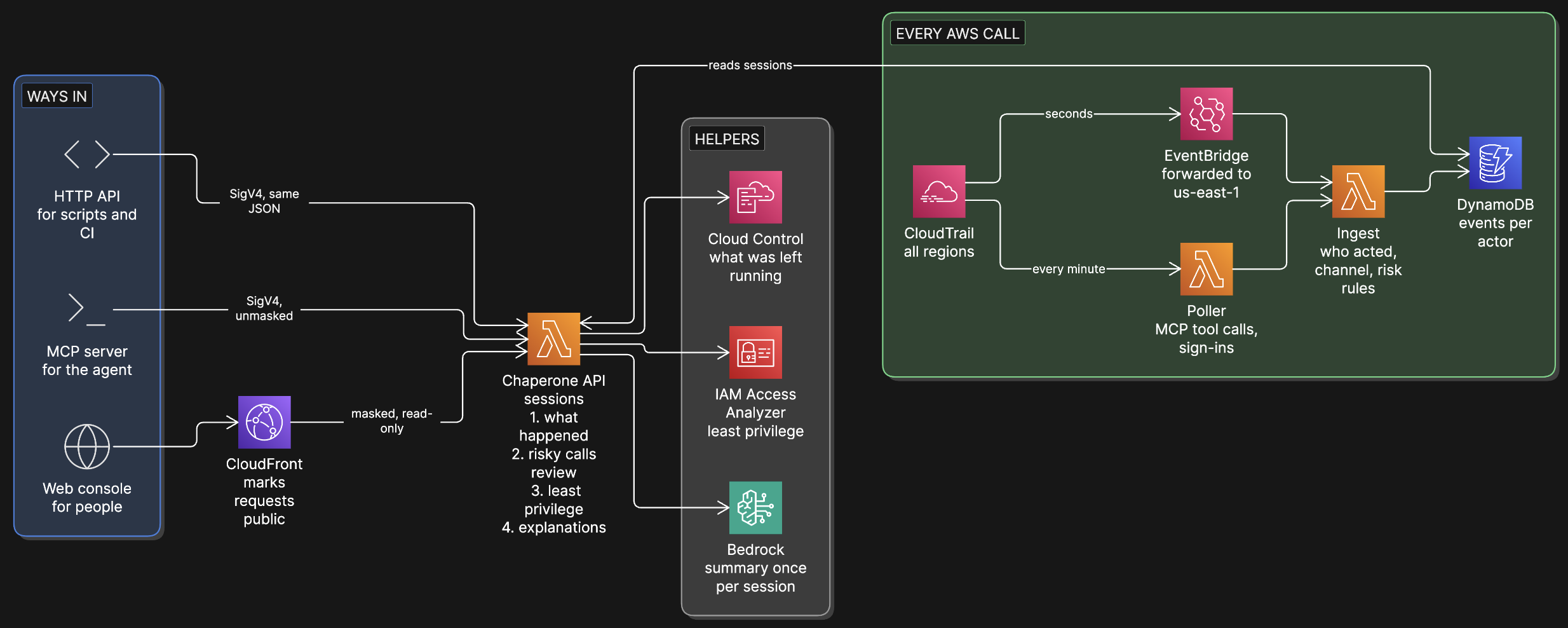
Claude Code or any MCP-capable agent asks about its own session ("me") before it reports back.
This site: the flight path, every change riskiest first, and a plain-English summary per session.
The same JSON over a function URL with IAM auth: anything that can sign an AWS request can ask.
sessions · what happened · risky calls · review · least privilege · explanations
CloudTrail in every region, attributed to agent or person, classed by fixed rules
Same answer everywhere
The MCP tool, this site and the API read one query layer. Only the masking differs.
Not tied to one agent or channel
It records MCP, Terraform, the CLI, SDKs and the console, and flags an agent working on a person's identity.
Safe by construction
Signed callers get the full record. This public site gets a masked, read-only view that can't start work.
The agent checks its own work
Chaperone is also an MCP server in the agent. Here Claude Code asks it "was anything I did risky?"
Claude Code created and deleted a queue through the AWS MCP Server, then asked Chaperone "was anything I did risky?" The answer comes from CloudTrail, which the agent didn't write and can't edit: one destructive call, on a queue the same session created.
risky_calls("me") →
{
  "risky": {
    "destructive": {
      "calls": [{
        "time": "2026-09-27T22:30:13Z",
        "action": "sqs:DeleteQueue",
        "target": "https://sqs.us-east-1.amazonaws.com/111122223333/chaperone-demo-queue",
        "via": "mcp",
        "tool": "aws___run_script",
        "reasons": ["sqs:DeleteQueue removes or stops a resource"],
        "on_resource_created_this_session": true
      }]
    }
  },
  "summary": { "destructive": 1 }
}
Verify it on a session
Look at three things in this session:
- 1
The summary
The top panel says in plain English what the agent did.
- 2
The flight path
One lane per channel. Click a key icon to see why an IAM change was flagged.
- 3
The access it needed
It was allowed
"Action": "*". See what it actually used.
Other details
A real agent with its own identity
Claude Code runs on a Linux VPS and reaches AWS through the AWS MCP Server, signed in as its own IAM Identity Center user, chaperone-agent. CloudTrail records each tool call as an event from aws-mcp.amazonaws.com whose user agent names Claude Code. Those events are the top lane of every agent session here; click one to see the AWS calls under it.
Five MCP tools, for any MCP-capable agent
list_sessions— recent sessions in the account, newest first, each with its riskiest call.what_did_the_agent_do— one session: each MCP tool call with the AWS calls it made, and what it created and deleted.risky_calls— the calls above plain writes, grouped by risk class, with the rule that flagged each one.review_session— what the session left running and its monthly cost, plus IAM deny guardrails checked by Access Analyzer.least_privilege— the permissions the session actually used, as a policy, compared with IAM Access Analyzer's.
Asked for session "me", the agent reviews its own latest session before it reports back. The server runs with the developer's own AWS credentials, so it can't be tried from this page; the repository has the setup steps.
Rules decide risk, not a model
- Serverless: CloudTrail, EventBridge, Lambda, DynamoDB, CloudFront, S3, Bedrock, IAM Access Analyzer, Cloud Control.
- All infrastructure in Terraform. Risk classes come from fixed rules, tested on real recorded events.
- The plain-English explanations are written once per session by a Bedrock model and stored.
ARCHITECTURE.md has the decisions behind it.
This site is masked and read-only
- CloudFront marks every request from this site as public. In that view the API masks account IDs, role suffixes, identity IDs and IP addresses, and refuses anything that starts work. Try
/api/replay?id=me: it answers 403. Nothing a visitor does calls a model. - Chaperone records and explains; it never blocks, deletes or reverts. A recorder that acts would be one more agent to watch.
- Events appear a few minutes after the call, as fast as CloudTrail delivers them. AWS doesn't record the scripts an agent sends through MCP, so Chaperone shows what was called, not the code.
$0.07 for the whole account in September
By Cost Explorer, up to the 27th. Explanations cost a few cents per session, once.